Community
Building community with those of minoritised identities is one of the most important things to me. Feelings of isolation stemming from displacement or disconnection make us vulnerable + invisibilise us in a way that serves to exploit and mistreat us.
As such, I believe community-building is a method of political resistance where we can model and explore what true care can actually look like as an active practice.
I aim to use art - that is various disciplines of creative expression - as a tool for community engagement and building. Art is for everyone and using it as a method of community engagement connects us to each other, resisting the rising tides of facism that aim to separate us, and building stronger networks where nobody is left behind.
I believe this begins with curating and holding spaces where we can Come As We Are, where we don’t leave part of who we are at the door.
Please see the drop-down sections below to learn a little more about my own values-led approaches to this!
-
Spaces I facilitate and projects I co-ordinate are ruled by a Come As You Are principle. This is a short-hand way of saying you don’t need to come to the space and perform a version of you that feels in conflict to who you are that day. You are welcome as you are whether that’s in your soft comfy clothes, only half able to concentrate, or with all the anxiety of trying something new (etc)!
You are always allowed to diverge from whatever it is I’m delivering. Breaks can always be taken or asked for. No-one will ever demand something of you that you don’t want to do, whether that’s speaking or sharing.
The spaces I want to create are opt-in.
I aim to make them as safe as is possible and as accessible as possible. That means rejecting traditional methods of facilitation that have burned so many of those who need community.As a multiply disabled person I have my own access needs to honour and navigate, and I extend that compassion to all I’m building community with. The only rules there are are ones to protect us, not to police you!
-
Working in mutuality is very important to me.
What I mean by this is dismantling the power hierarchy between facilitator and participant by engaging in the creation of art alongside the people I’m with.I believe the workshop space to be a ‘third space’ where micro-communities are formed to create, explore and grow with one another. Working alongside each other, instead of in a traditional teacher-student dynamic, collectively rejects a classist (and therefore also racist) cultural rhetoric that insists art is not for everybody, and relegates people into either artist or consumer.
The resisting of this, for me, is an extension of my community values and engages in what I consider a ‘loving work’.
-
Similarly, this loving work means remaining curious in the ways I’m able to. I believe this deeply involves remaining accountable and open to reflection and change. This means being able to recognise the moments where I might have misstepped, created tension or rupture, or might need to apologise or engage in repair.
As such, I try my best to stay open to correction and stay curious about what is brought to me by anyone I’m engaging with regardless of age, social hierarchy or level of education etc.
At its foundations, community cannot prosper without the ability to call others in, reflect, learn or engage in suitable repair. I strongly believe that by modelling the values I speak of, a more loving, open and collaborative space can be created.
Compassion is not theoretical, but a practical skill we must work on. Compassion must be the soil we plant ideas in!
-
There is no such thing as a one-size-fits-all standard of accessibility.
Group-wide access requirements will undoubtedly clash at some point - what one person might need might be the total opposite of what someone else needs. This complexity is often used to scapegoat a lack of willingness to try and meet the needs of the people in a space, which is, of course, ableism.
I believe the best thing we can do in third spaces is to curate an environment where we each feel empowered to ask for what we need, what we would prefer less of, and ultimately feel able to manage our own engagement in a protected space.
I use protected space over ‘safer space’ because I believe that no space can be truly safe - that is, free from triggers, conflict, discomfort and potentially hurt. However, I do believe a space can and should be free from harm - that is, any lasting emotional or psychological damage.
My preferred method of attempting to protect a space is through facilitating an initial open session where a group agreement is mutually created. This agrees on what respectful engagement looks like + might outline protocols for occurrences of conflict or hurt.
-
A special interest of mine is how trauma can manifest in the body and psyche. When our lives have been impacted by trauma we are liable to have triggers - that is, things that emotionally and psychologically distress us.
Working in a trauma informed way means understanding that every individual person arrives with their own personal experiences and might have triggers that may not seem obvious to others.
To try avoid re-traumatisation, check-ins are regular, triggering content is appropriately signposted, and above all, everyone is encouraged to engage in active self-care where their personal agency will always be protected and supported.
The nature of triggers means they cannot always be avoided, but a compassionate response is one that asks “what do you need?” (or asks nothing as the case may be for some!)
This is something always covered when creating a group agreement.
-
Neurodiversity was a term coined to express that people process the world in an infinite constellation of ways. Like biodiversity, each person’s way of understanding and navigating the world is unique but exists in an ecosystem full of natural variation.
Neurodivergence reframes what was once conceptualised as a cognitive difference, ‘disorder’ or ‘deficit’, into an umbrella term that functions as a safe harbour for those who experience the world in ways that have been historically considered 'beyond the standard’.
This community-established term serves to reclaim those different - i.e ‘divergent’ - ways of being.
Similarly to my trauma informed approach, individual agency is paramount and everyone is always encouraged to ask questions when they need to, to stop or disengage when they need to, and self-regulation however comes most naturally to you is always encouraged!
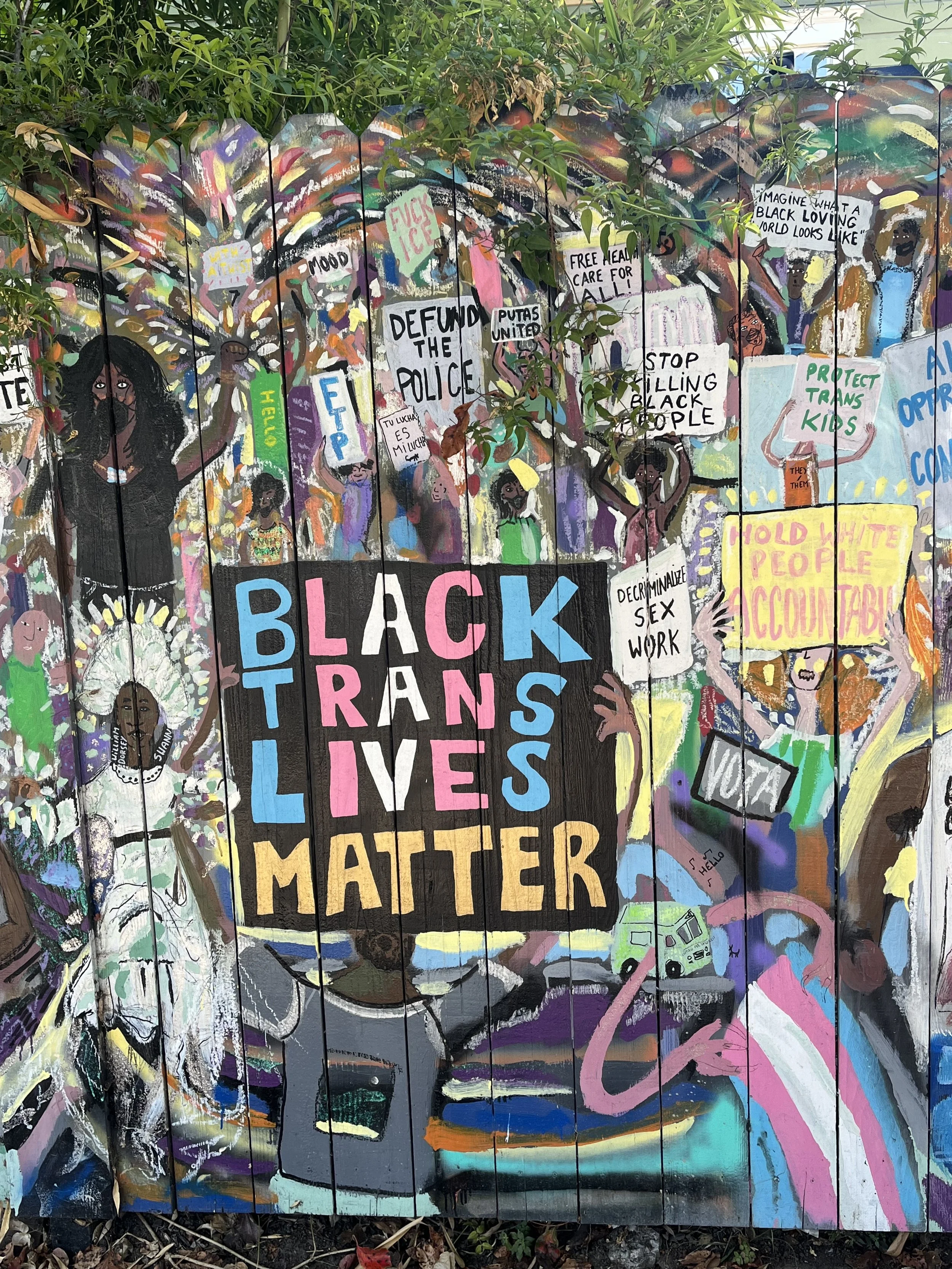
Image description: a photograph of graffiti of a protest with black figures carrying signs saying, “Black trans lives matter”, “protect trans kids” and “decriminalise sex work”.bell hooks